
You are about to learn the seven 7 qualities of a healthy relationship that makes love last. When most people think about relationships, they often picture romance, companionship, or even the excitement of falling in love.
But while those moments are beautiful, a truly healthy relationship goes much deeper than just butterflies in your stomach.
At its heart, a healthy relationship is about two people who respect, support, and care for each other while still maintaining their individuality.
It’s not about losing yourself to please someone else, it’s about creating a safe space where both partners can grow and thrive together.

In this article I want to talk about the meaning and keys to having a healthy relationship, the keys so that two individuals, each with their own personality, experiences and ways or perception life, can contribute something to each other for a long time (sometimes, a lifetime).
Healthy relationship meaning
So, what exactly does a healthy relationship mean? In simple terms, it’s one that is built on mutual respect, trust, honesty, and open communication. Both partners feel heard, valued, and secure, without fear of judgment or rejection.
A healthy relationship isn’t perfect, arguments and disagreements will happen but the difference is in how those challenges are handled. Instead of blame or manipulation, both parties work toward understanding and solutions.
One of the most important aspects of a healthy relationship is balance. You share your life with someone, but you don’t lose your identity in the process.
You can still pursue your passions, maintain friendships, and focus on personal growth, all while being supported by your partner. Likewise, you’re there to encourage and celebrate their achievements, too.
Another key element is emotional and physical safety. In a healthy relationship, you should feel comfortable expressing your feelings, setting boundaries, and being vulnerable.
There’s no room for constant criticism, fear, or control. Instead, love is shown through kindness, patience, and the willingness to grow together, even when things get tough.
What is meant by healthy relationship?
Ultimately, a healthy relationship means having a partner who brings out the best in you, and vice versa.
It’s about creating a connection where both parties feel valued, supported, and loved for who they truly are. And while no relationship is without challenges, when the foundation is strong, both partners can face life’s ups and downs together, hand in hand.
“A healthy relationship is a balanced partnership built on trust, respect, and open communication. It allows both people to feel valued, supported, and free to grow as individuals while building a strong bond together.”
What are the 7 qualities of a healthy relationship?
If I had to name just one indicator of whether a relationship should continue, it would be this; Does your relationship add to or detract from you? Does it help you become better and develop as a person?

Or, on the contrary, does it limit you and cause more discomfort than positive emotions?
1. Always love from freedom
To love from freedom means to be clear that the other person does not belong to you , that the other person is a person who freely decides to maintain a relationship with you and is therefore free to leave at any time.
Read more: How to Resolve Relationship Conflicts According to the Bible
To love from freedom means to accept that the other person has the right to make whatever decisions they want and to choose what they want to do with their life.
It means that everyone should have their own private space, their own privacy. Loving from freedom means we want to share our lives with the other, but we don’t need to. It means accepting that we are two different people and not a two -in-one.
It entails putting our insecurities aside and ensuring that the other person is with us because they want to, and not through manipulations that prevent them from finding someone better.
It also means our partner knowing thousands of people to be choose from but still preferring us.
2. Learn to communicate
Good communication is one of the basic pillars of a couple, since dialogue is what allows for the creation of a shared life project, where it is very important to negotiate, compromise, and reach agreements.
Proper communication can turn arguments into something constructive and bring couples closer together, instead of separating them and creating resentment.
Furthermore, setting aside time each day to talk with our partner about anything is an excellent habit that will help strengthen and maintain a satisfying relationship.
The area where inadequate communication causes the most problems is in arguments.
We can learn to argue constructively, in which we offer our point of view respectfully and explain how we feel, without entering into a vicious cycle of blame and accusations, where we’re likely to end up arguing about something that happened years ago, leaving aside the issue that started the argument in the first place.
I’ll leave you with some guidelines to learn how to discuss constructively:
- Discuss only one topic at a time.
- Talk about how you feel, don’t accuse others.
- Avoid generalizations (always, never, everything, nothing) and talk about a specific fact.
- Use a friendly tone and avoid discussing a topic when your anger level is very high.
- Ask for what you want, specify the change (e.g.: I would like the next time we go to my mother’s house to be before lunch and not in the middle of the afternoon).
- Don’t get caught up in the other person’s reproaches and ignore them if they attack you or change the subject. (For example: “We can talk about that topic another time if you want. I’m trying to tell you right now…”)
- End the criticism with something positive (e.g., “Thank you for listening to me and I hope this issue gets resolved, as I love being with you”).
- Practice assertive communication.
I know this is really complicated, and sometimes you feel like yelling at your partner and throwing things all over the house, but I assure you that if you take a deep breath, wait for your arousal level to drop before speaking, and use these guidelines, you’ll get much better results.
3. Learn to think green
Each person on earth has had different experiences and a different previous learning history, which is why they have a different personality and see the world in a different way than you do.
If you put on blue glasses and I asked you what color you see the world, you’d tell me blue, right?
And no matter how hard I try to prove to you that it’s yellow and that you’re not seeing it correctly, it will be impossible for you to agree with me, since your world is actually blue.
Our learning history leads us to see the world in one color or another, and for us, the world will simply be that color because that’s how we see it.
The problem is when for one partner the world is blue and for the other it’s yellow, this is the time to think green .
You don’t always have to agree with what your partner thinks. I think we’re too focused on being right, when the ultimate goal is to resolve the conflict.
When you notice that you both have completely different points of view, instead of continuing to argue over whether you’re right or not, propose compromise solutions that include both points of view . Not blue, not yellow, just green!
4. Share quality time with your partner
Spending quality time with your partner is key and a notable quality to ensuring your relationship doesn’t become mired in a rut.
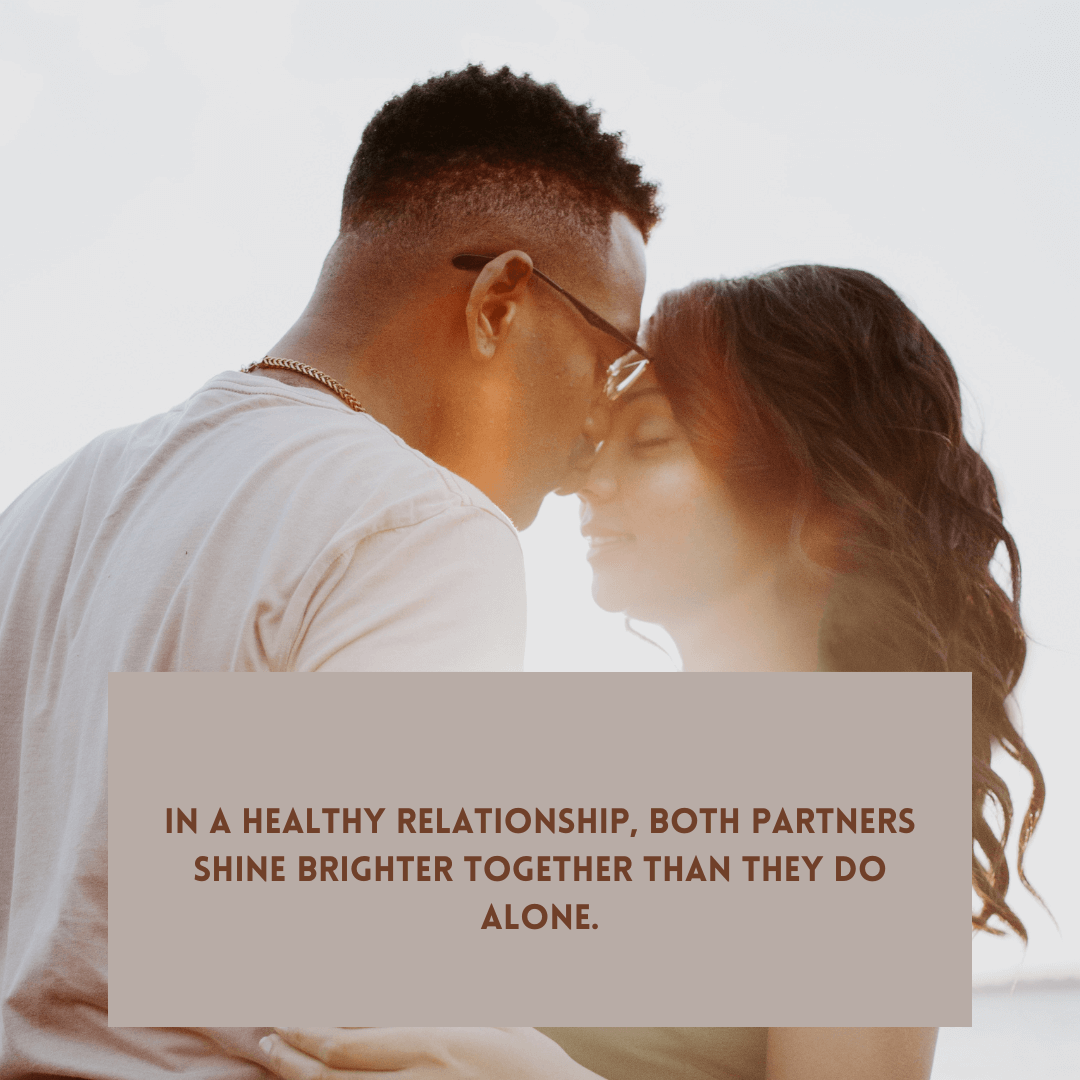
“A healthy relationship is where love feels safe, respect runs deep, and both hearts grow stronger together.”
I understand that sometimes we lead very busy lives and practically live on autopilot without realizing what’s happening around us, but setting aside some time to share with your partner should be among your priorities if your goal is to maintain a healthy relationship.
Going out for dinner one day, a weekend getaway, your favorite movie with popcorn, etc.
5. Never stop caring for the relationship
At the beginning of a relationship, we tend to show our best side to the other person, we’re thoughtful, we pay compliments, etc.
However, over time, these gestures tend to diminish until they sometimes disappear.
Relationships are like plants; if you don’t water them, they die. So, if you want to keep your relationship fresh and colorful, never stop watering it.
Something as simple as telling the other person how handsome they look today, giving them flowers, inviting them to dinner, taking them to the place where you first met, etc. can keep the relationship in excellent condition for a long time.
6. When you want the other to change, change yourself
I think we spend too much time trying to change people, most of the time without any results. People only change when they want to change, or when their environment changes.
Therefore, if what we want is for our partner to change, the best thing we can do is change ourselves .
If we want him to stop going out so often with his friends, it would probably work better to thank him for the days he stays with you all afternoon than to reproach him every time he goes out.
If we want him to be more affectionate, what about if we start showing more affection ourselves?
7. Respect and trust
Without respect and trust, there is no possibility of a healthy relationship. Love is respect and trust , and without respect and trust, there is simply no love.
When it comes to love, two words stand out as non-negotiables; trust and respect. Without them, even the strongest attraction or the sweetest moments can quickly fade.
Think of trust and respect as the foundation of a house, if they’re shaky, everything built on top eventually crumbles.
Trust is what allows you to feel safe with your partner. It’s the confidence that they’ll be honest, loyal, and dependable, even when you’re not around.
Trust isn’t built overnight; it grows slowly through consistency, honesty, and transparency.
Something as simple as keeping promises, showing up when you say you will, or being open about your feelings builds that sense of reliability. When trust is strong, love feels secure rather than fragile.
On the other hand, respect is about valuing your partner as an individual, not just as “your person,” but as someone with their own thoughts, feelings, and boundaries.
Read more: 13 Major Red Flags in a Relationship You Should Never Ignore
Respect shows up in everyday actions: listening without interrupting, supporting their goals, and never belittling or dismissing their opinions.
It also means honoring their boundaries, whether emotional, physical, or personal. In a respectful relationship, both partners feel equal, neither one dominates, and both voices matter.
Here’s the truth: love without trust and respect isn’t really love, it’s attachment, control, or dependency.
But when trust and respect are present, they create a safe and nurturing environment where love can thrive.
Couples who trust each other don’t feel the need to constantly check phones or question every move.
And when respect is mutual, disagreements don’t turn into shouting matches, they become opportunities to understand each other better.
In the long run, trust and respect turn passion into partnership. They transform love from something fleeting into something lasting, helping couples weather challenges and celebrate victories side by side.
Final thoughts on how to make a healthy relationship.
At the end of the day, a healthy relationship isn’t about being perfect or never having disagreements, it’s about how two people choose to treat each other through it all.
Love grows stronger when it’s nurtured with respect, trust, honesty, and open communication.
It’s the small, consistent efforts, listening without judgment, showing appreciation, and supporting each other’s dreams, that keep the bond alive and thriving.
If you’ve ever wondered whether your relationship is truly healthy, ask yourself: Do I feel safe, respected, and valued here? Do I feel free to be myself while also growing with my partner? If the answer is yes, then you’re on the right path.
And if not, remember that change is always possible, healthy love takes effort, patience, and a willingness to grow together.
Building and maintaining a strong, healthy relationship is a journey, not a destination and these 7 qualities of a healthy relationship is indispensable in this journey.
So keep showing up, keep choosing kindness, and keep investing in each other. Because when love is rooted in trust and respect, it doesn’t just survive, it flourishes.